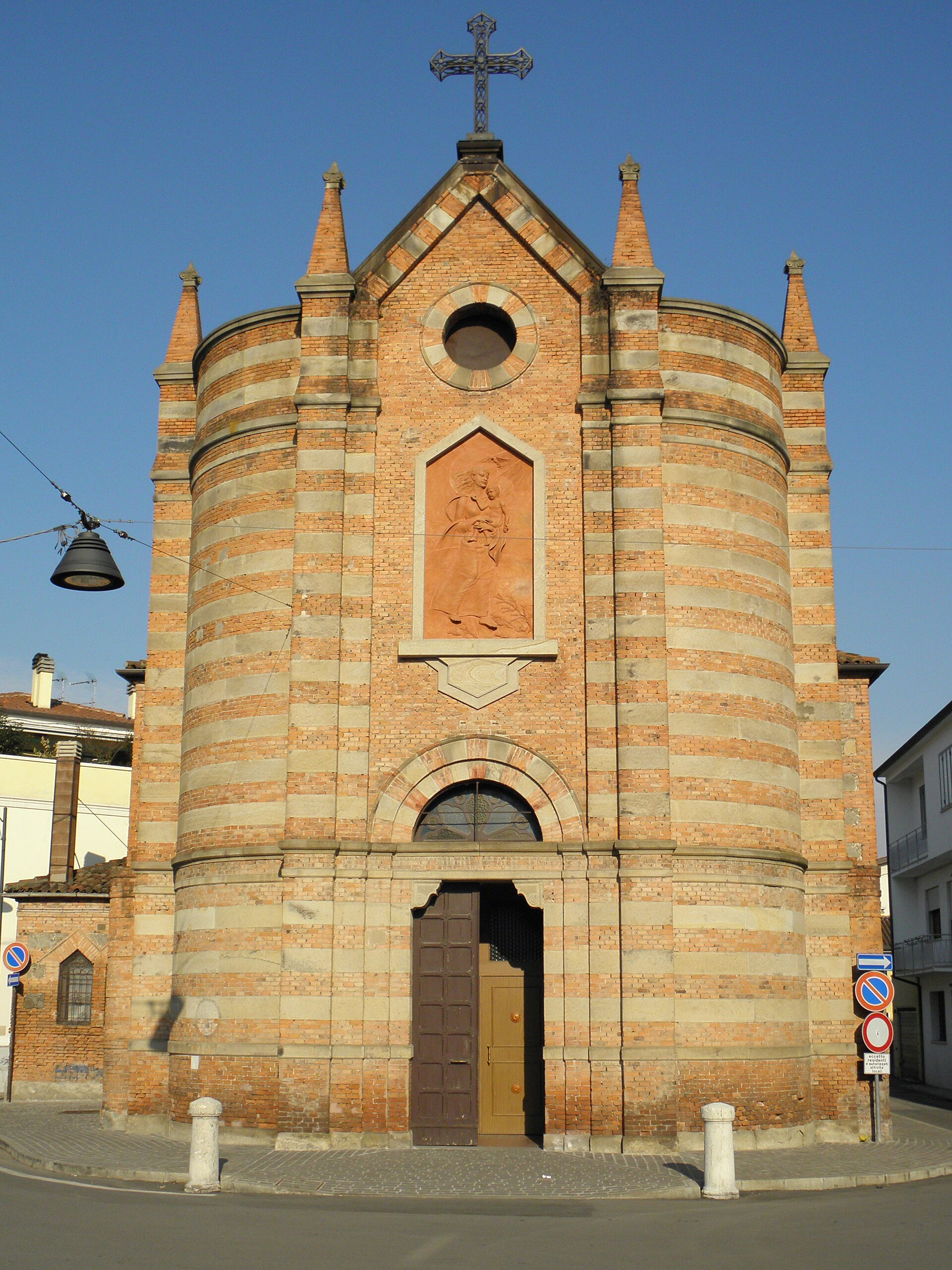
Its popular name tells of a Rovigo you can no longer see. ‘Le Fosse’, the Ditches, was the old name of today’s Via Gorizia. According to the Veneto Region, it referred to a very poor and unhealthy part of the old city. Right here, at the beginning of the 20th century, a small church was built in honour of the Blessed Virgin of the Rosary of Pompeii. Its official title is Oratorio della Beata Vergine di Pompei. The street has changed its name, but the Fosse live on in the church’s nickname.
A church for those on the margins
It was commissioned by Don Tommaso Angiari, designed by the architect Eugenio Piva, and built in the very heart of the Fosse. The Comune di Rovigo dates it to 1900–1903. It is an example of early 20th-century sacred architecture, born of the great Marian devotion of those years. Of the churches on this trail it is the youngest: little more than a century old.
The Madonna of Pompeii was a popular cult all over Italy in the late 19th and early 20th centuries. Bringing it to a poor neighbourhood meant giving a place of prayer to those living on the edges of the city.
Grey and red stones
The façade is Neo-Gothic, built of alternating grey and red stone. This play of colour sets it apart from every other church in the centre. It is a façade that catches the eye for its colours rather than its size. If you come closer, look for one detail: the terracotta bas-relief of the ‘Madonna del Cammino’, Our Lady of the Way.
The little church is one of the smallest and least known places of sacred Rovigo. Yet its story is already written in its name. It recalls a Rovigo that has vanished, and the poor people who lived there. That is why it is the perfect stop on a walk through the hidden folds of the city, where even a two-tone façade can tell of those who came before us.