Genoa, July 1857. A Mazzinian uprising has just failed and the police are filling the prisons. Among those arrested is a young nobleman from Lendinara, Alberto Mario. In prison he meets another detainee, an English journalist: her name is Jessie White.
Alberto was born in Lendinara on 4 June 1825, into a family that had come from Ferrara centuries earlier. As a student in Padua, on 8 February 1848 he had taken part in the demonstration against the Austrians. He had then fought as a volunteer at Cornuda, Treviso and Vicenza.
Jessie was born in 1832 near Portsmouth, into a family of shipowners. She had tried to study medicine in London but had been turned away because she was a woman. Mazzini had persuaded her to raise funds for the Italian cause. Once out of prison, she and Alberto married in a civil ceremony in Portsmouth on 19 December 1857.
From then on their lives followed the course of the Risorgimento. In 1860 they left for Sicily with Garibaldi's expeditions. In Palermo, at Garibaldi's invitation, Alberto ran the Military College for a time, then fought at Milazzo and moved up the peninsula to Naples. He would tell the story of those months in a book published first in London and then in Italy, La camicia rossa (The Red Shirt). In 1863 he refused his seat as a deputy so as not to swear allegiance to the monarchy. Jessie wrote biographies of Garibaldi, Mazzini and Cattaneo.
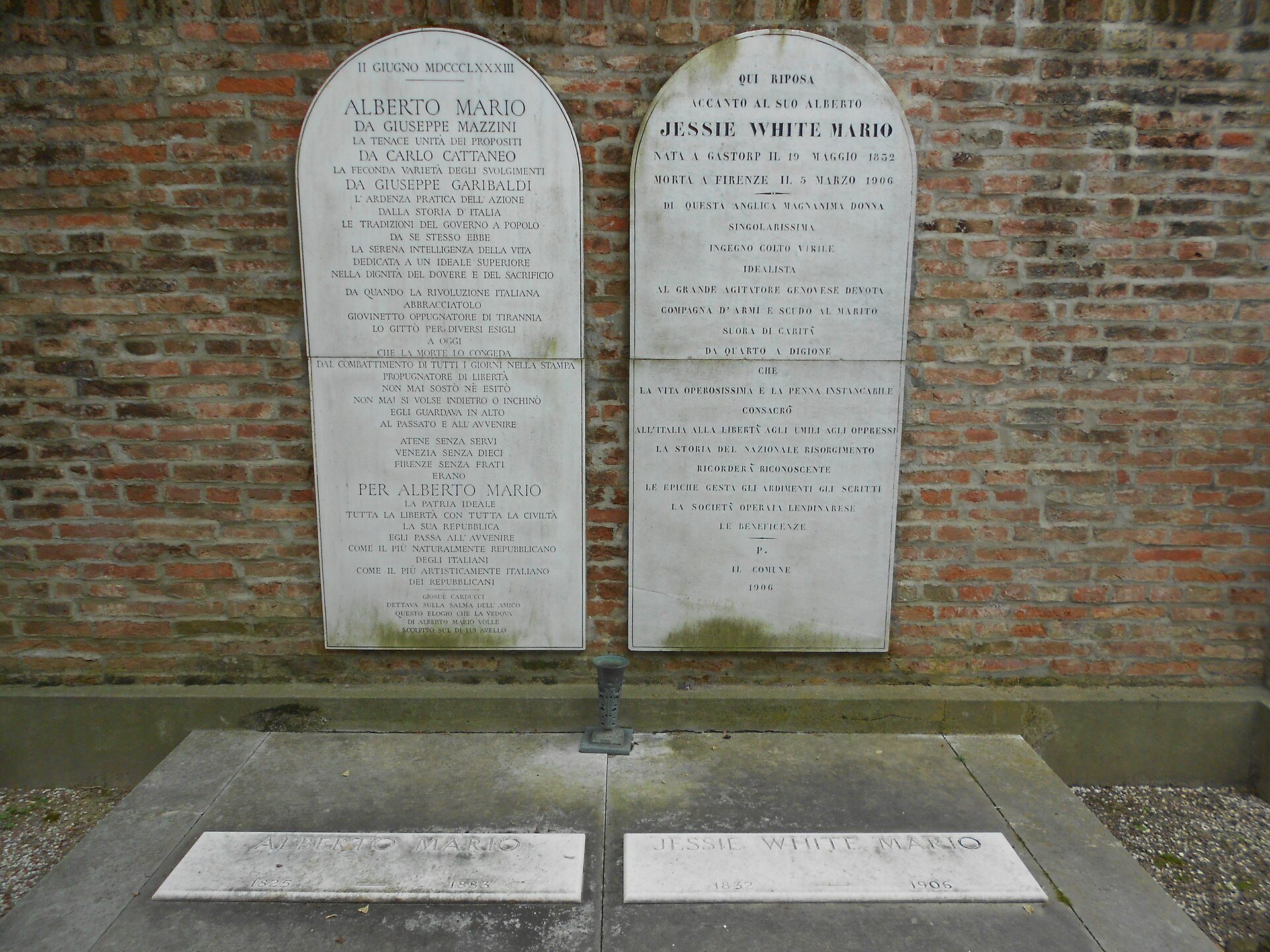
Alberto Mario died in Lendinara on 2 June 1883, exactly one year after Garibaldi. He was buried in the garden of his house, and in 1899 his body was moved to the town's new cemetery. Jessie died poor in Florence on 5 March 1906. Her ashes rest beside him.
In Lendinara their story can still be followed step by step: from the streets of the historic centre to the cemetery where the couple from the Genoa prison are side by side once more.