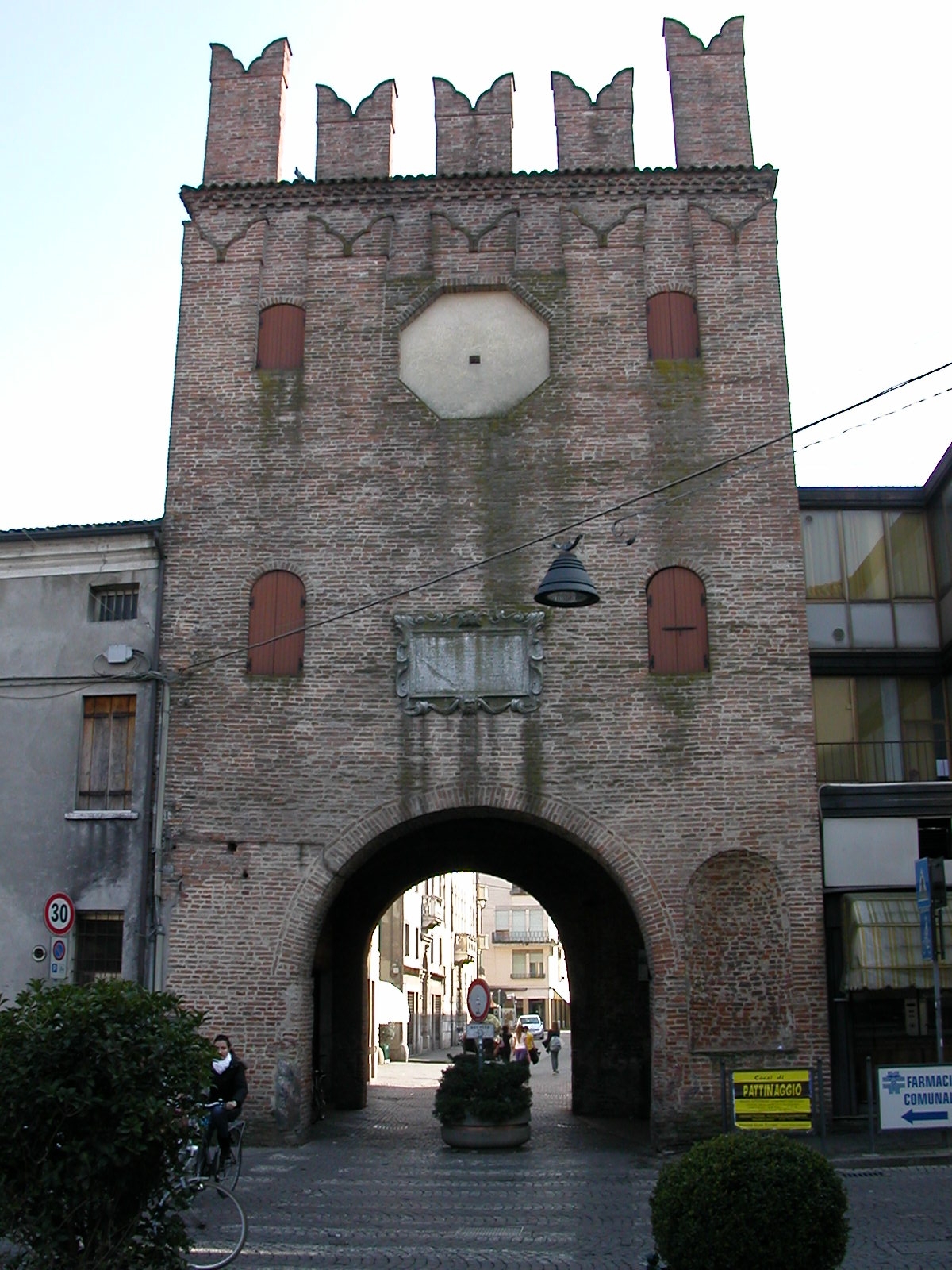
It is the best-preserved gate of Rovigo’s old walls, and one of only two entrances to have survived. It was built between 1482 and 1486, under Doge Giovanni Mocenigo. These were the years when Venice wrested the city from the Este family in the War of Ferrara. From its position in Piazza Merlin, it guarded the way into the old town, on the left bank of the Adigetto canal. Anyone entering the city from this side had to pass beneath its arch: it was, quite literally, the city’s threshold.
A 17th-century Middle Ages
The structure is of brick and terracotta, with a single arch adorned with noble coats of arms and cornices. It rises to just over 18 metres. Inside survive two supporting buttresses and the groove of the portcullis that once closed the passage. One look at the archway is enough to picture the grille coming down to bar the city. The medieval look we see today, however, is more recent than it seems. The double row of Ghibelline battlements, with their swallowtail merlons, dates in fact from 1639, when the podestà (Venetian governor) Vittore Correr also had a two-faced clock installed. The gate was damaged during the War of Ferrara and has been restored several times, most recently in the 1960s.
At the centre of the façade stood a sculpture of the Madonna and Child with the infant Saint John, by Clemente Molli. Today it can be seen in the Church of the Beata Vergine del Soccorso, known as the Rotonda. A short journey, from the gate of a fortified town to the inside of a church. Even stones, sometimes, move house.
Saved by the city
While the city’s other gates were demolished in the 19th century, the “Volto” survived, absorbed into the urban fabric. That is also why it stays closed today: private homes and shops built up against the tower block any way in. To admire it, stop in the square and look up towards the battlements. It is one of the places highlighted by the FAI, Italy’s National Trust: a sentry that has held its post for more than five centuries.